Legend of the Water Melon


Once upon a time, the sixth son of King Hung Vuong the Fifth named An-Tiem disobeyed the King's order and was exiled to a deserted island.

The Prince had to build his own shelter, dig a well for water, and fish and hunt animals for food. One day, he found a green fruit as big and round as a ball. He split the fruit into halves and found the inside of the fruit red. He dared not eat it because he was afraid it was poisonous.

Days passed and the dry and sunny season came. It was so hot that all the plants were dry and the well had no water left. One day An-Tiem was so tired and thirsty that he tasted the fruit He found out that it tasted delicious and quenched his thirst. He tried to grow the plant around his house then. Soon the whole island was covered with the green fruit.

An-Tiem carved the island's name and his own on some of the fruit and threw them into the sea. Later, seamen found the strange fruit with An-Tiem's name floating in the sea.

Soon, words about the fruit reached the continent and many merchants tried to find the way the island. This then turned the deserted island into a busy island. The island was now crowded. Many boats came and went. An-Tiem helped anyone who wanted settle on the island. Soon, news about that reach the King.

King Hung Vuong was very proud of having a son who was brave and strong enough to overcome difficulties without anyone's help. An-Tiem was immediately summoned back to the court. He brought his fruit with him to offer the King, his father. The King gave him his crown and An-Tiem became King Hung Vuong VI.

Since then the fruit which was called "dua hau" and has become the symbol of luck; people often offer it to relatives and friends as a New Year present.

The Story of Truong's Wife


 The temple to Truong's wife is located on the side of the Hoang river, village of Vu dien, district Ly Nhan, province of Ha Nam. Here is her story.

She married a man of the Truong family. After a half a year, he was conscripted to go and fight a distant war. When he left, she was pregnant. She gave birth to boy, which she name Dan. During her husband absence, as she sat with her child, she would point to her shadow and would tell him that that was his father. After three years, her husband was released from service and came home. The boy by then could talk. When he called him, he replied:

You are also my dad? How can you talk now? My dad used to be silent. He came at night. He would sit when mom sat. He would move when mom moved.

The husband was struck by what his son has revealed to him. He became suspicious, then questioned his wife and did not believe when she denied having been with another man. He gave her such a hard time that in despair she jumped in the Hoang river to kill herself to prove her faithfulness.

Then one night, as he sat with his child, he pointed to the shadow of his father on the wall and said:

My dad has come back, see!

It finally struck the husband that his wife has used her shadow to provide the boy with as a surrogate father. As he came to recognize the injustice he did onto his wife, he built a altar on the river edge so that he can make offering to help free her soul. The people of the village subsequently built a temple in her honor. King Le Thanh Ton (1442 - 1497) on a tour of this province passed the temple and this inspired the following poem about her temple:

This column of incense smoke by the whirlpool

Is this the temple of the wife of Truong.

When the oil lamp is out, do not listen to the child,

Why the river to bring her misfortune.

Witnesses of her faithfulness are the sun and the moon

Why is it necessary to have an altar to redress the injustice

Passing by we learn the ins and outs of this story

Truong you have been too harsh!

King Le Thanh Ton reigned from 1460 to 1497. He was one of the enlightened King of the Early Le dynasty. He made political reforms and also was a patron of the arts. He founded the 'Tao dan nhi thap bat tu', the 28-star literary society, and was their leader.

The Golden Ax


There was once a very poor man who lived near the forest. He was able to earn enough for a bare existence by cutting firewood, which his wife would barter for rice in the market place.

One day, when this man was cutting wood at the river's edge, the ax slipped from his hands and fell into the water. Although the woodcutter searched for it everywhere, it was not to be found. Discouraged, he sat down on the bank, lowered his head sadly, and wondered how he would be able to earn a living in the future. When the man raised his eyes again, he saw a little old man standing in front of him. The newcomer asked the woodcutter the reason for his unhappiness. The latter described what had happened and added that the lost ax had been his most valuable possession. Only with it would he be able to earn his daily rice.

"I am the dragon of this river," said the old man sympathetically, "and I am going to help you. If you will wait here for a minute, I will recover your ax for you."

With these words the old man plunged into the water. A few moments later, he reappeared, holding a golden ax in his hand.

"Is this your ax?" he asked.

"No," replied the woodcutter, "that is not mine. My ax was made of iron and had a wooden handle."

The river-dragon plunged into the water again and then emerged holding aloft a silver ax.

"Is this ax yours?" he asked.

Again the honest woodcutter replied in the negative.

The dragon then submerged for a third time. When he reappeared, he was holding a very ordinary iron ax in his hand.

"Is this your ax?" he asked the woodcutter.

"Yes," came the reply, "that is mine, and I thank you from the bottom of my heart for your assistance."

"You are an honest man," said the river-dragon then. "For that reason, in addition to this iron ax, I am going to give you one of silver and one of gold as well."

It was difficult for the simple woodcutter to find words with which to thank his benefactor. He picked up the three axes and returned to his cottage.

The evidence of all this new wealth soon aroused the speculation of the woodcutter's neighbors. With the exception of one man, however, they all wished him well.

This man was full of envy and was greatly desirous of obtaining for himself a golden or silver ax. From the woodcutter he obtained an exact description of the place on the river bank where the miraculous event had taken place. The greedy man then found an old, rusty ax and went there with it. He threw the iron ax into the water and pretended to be greatly troubled because of its loss.

The little old man appeared before the man and asked the cause of his trouble. Falsely the man described his loss and begged for the old man's assistance.

"You shall receive justice," was the reply. Thereupon, the old man plunged into the river and reappeared with a golden ax in his hand.

Before the dragon even had time to ask the question, the man shouted, "That's my ax. Give it to me at once."

"You are lying," replied the dragon angrily. Raising the ax high in the air, he struck the liar a blow on the neck, killing him instantly.

Since that time, no one has ever tried to obtain a golden ax or even a silver one from the river-dragon's hoard.
.................................... 
Note. This story is probably of Buddhist inspiration but Confucianists would also approve of its moral: Greed is indicted and punished; honesty is rewarded. It also illustrates Vietnamese belief in the supernatural river-dragon, a generally beneficent creature, who is said to inhabit the depths of every stream and to be able to assume human shape at will.

The Story of Luu Binh and Duong Le


Luu Binh Duong LeLong ago there were two very close friends. One named Luu-Binh, came from a wealthy family; the other, named Duong-Le, came from a poor family.

Knowing that Duong-Le did not have enough money to study, Luu-Binh kindly invited him to come and live with him to help him. Conscious of his poverty, Duong-Le was hard working and industrious while Luu-Binh, satisfied with his wealth, was wasteful and lazy. As expected, when the final examination arrived Luu-Binh failed while Duong-Le succeeded. He then became a high-ranking official and lived comfortably in a big house in the capital.

Luu-Binh went on with his idle, wasteful and extravagant way of life. Soon he had squandered all his fortune and was still not graduated. Reduced to bare poverty, Luu-Binh then remembered his old friend, now a high ranking official. So he made the trip to the capital and called at Duong-Le's to ask for help. Duong-Le pretended to be cold and indifferent because he knew his friend too well. If he helped him at once he would be always lazy.

"You're not my friend. All my friends are rich and important people, not poor and ignorant like you." he shouted at Luu-Binh contemptuously. He then called: "Guards! See the man out. Give him some leftover rice and salt!"

Ashamed and disappointed to see that his friend was not too proud to remember their lifelong friendship, Luu-Binh sadly returned to his village, determined to study hard so that he would one day erase this shame.

In the meantime Duong-Le told his beautiful third wife, Chau-Long to dress as a girl selling silk, to go to Luu-Binh's village, get acquainted with Luu-Binh and then propose to stay with him. She would be selling silk and supporting him while he was studying. She also promised that they would become husband and wife once he successfully completed his studies. Encouraged by that promise, Luu-Binh studied hard day and night. It was not long before the examination came again and Luu-Binh passed it. As soon as he heard the result he hurried home to share the good news with Chau-Long only to find that she had disappeared.

Later on, Luu-Binh, too, was invited to serve as a high ranking official. But he did not forget the shame Duong-Le had caused him in the past. So he went to Duong-Le's to seek revenge. Duong-Le treated him completely differently when he arrived. This time he greeted him with open arms. He did not mind his friend's harsh words. Patiently waiting for his friend to calm down, Duong-Le then called his wife Chau-Long out to introduce her to his friend. Only then did Luu-Binh realize that Duong-Le, a true friend, had really helped him complete his studies. Both friends ran to each other and hugged each other tightly.

The Moon Boy


Long, long time ago there was a clever boy whose name was Cuoi. He did nothing with his cleverness but to play trick on people around him. He lived with his uncle and aunt who were usually suffered from his cheats.

Once day Cuoi came to the field and broke the bad new to the uncle that his wife had fell down from the ladder and bled. The man was so frighten that he ran to his home without saying a word. Cuoi at that time reached the house before his poor uncle by a short cut then broke another bad new to his aunt that her husband was collided by the buffalo and was going to died. The poor woman was scared and immediately ran out to the field. Suddenly she bumped to a man and recognized that it was her husband who was panting and sweating like her. The poor couple came back with anger and decided to imprison him into a bamboo cage then drifted him in the river.

In the afternoon when Cuoi was carried to the river’s bank, he regretfully said sorry to them and asked them to come back home to bring him a book hidden behind the basket of rice that taught him telling lie as the last favour. They both agreed and returned home to satisfy their curiosity without saying a word.

After that Cuoi saw a blind man passed by. He then asked the man to untight the cage if he wanted to have his eyes cured. At last Cuoi was free and hid himself in a bamboo grave and luckily found a jar of gold. He came back and gave it to his uncle and his aunt to atone for faults while the poor blind man was waiting for his eyes treated.

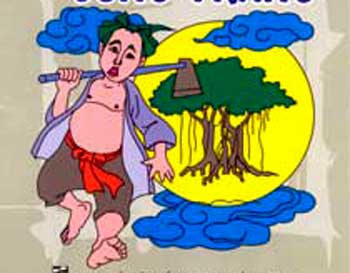
Later Cuoi got married with a girl in the village and went on pulling people’s leg. Once morning he came into the forest and saw a tiger mother picking leaves from a kind of tree to cure her son’s wound. Immediately the wound was recovered and the tiger baby could follow his mother to continue their trip. Cuoi grasped the opportunity to uproot the tree and rose it in the garden behind his house. He called the tree Banyan and took good care to it. He always reminded his wife that the tree was magic one so it was impossible to pour dirty water or dump the garbage at its root otherwise it would fly to the heaven. His poor wife sometimes envied with the tree so she dumped garbage at the tree root once day.

When Cuoi came home he found the tree was shaking and flying higher and higher in the sky. He tried to hold its root to pull it back but he couldn’t. The tree actually pulled him farther and farther from the earth until it reached the moon.

It is said that there is still image of Cuoi sitting at the root of Banyan tree and looking down to see the world and there is also a Vietnamese saying ” lie as Cuoi”.